
Commercial Epoxy and Resin Flooring in Dubai and the UAE
Commercial-grade epoxy and resin flooring specified, supplied and installed across UAE industrial, healthcare laboratory, F&B commercial kitchen and pharmaceutical sectors. Self-levelling and broadcast epoxy for chemical-resistant industrial floors, polyurethane (PU) concrete for thermal cycling in food and pharma kitchens, MMA for fast-cure refurbishment, anti-static and ESD variants for electronics and sensitive environments. Specified by chemical exposure, thermal demand, slip rating and downtime constraint. Free site survey across Dubai, Abu Dhabi and all 7 emirates. Operating since 2013 with 1,500+ commercial projects delivered.
Or call +971 50 362 7192
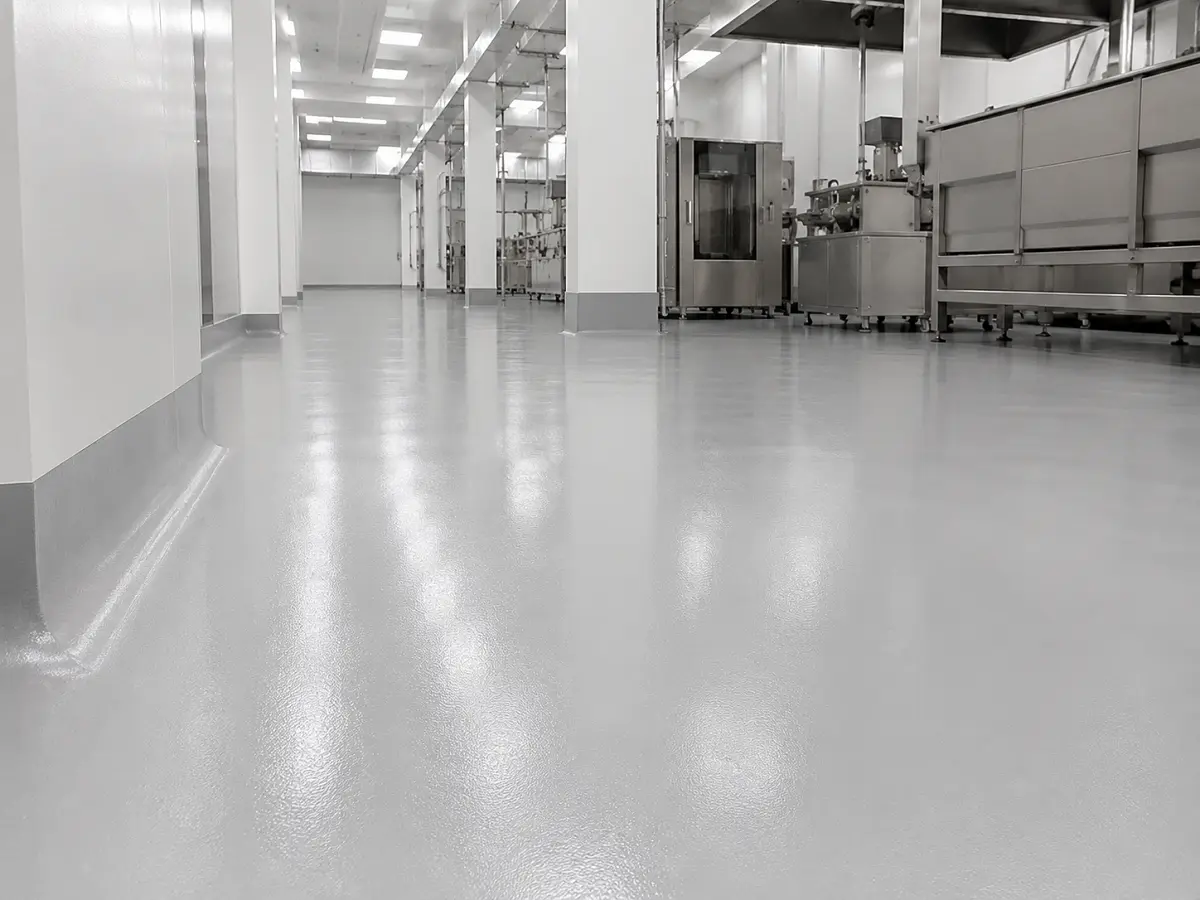
What Is Commercial Epoxy and Resin Flooring?
Commercial epoxy and resin flooring is seamless, chemical-resistant flooring formed by reacting a liquid resin with a hardener to create a continuous monolithic surface on a concrete substrate. The dominant chemistries are epoxy for general industrial and chemical resistance, polyurethane (PU) concrete for thermal cycling in food and pharmaceutical environments, and MMA for fast-cure refurbishment. The right resin depends on the chemical exposure, the thermal demand, and the downtime the project will accept.
What separates commercial resin from other commercial materials is that it is the only flooring system that delivers a genuinely monolithic, chemically impervious surface poured onto a concrete substrate. Welded sheet vinyl comes close in homogeneous form, but resin systems achieve complete continuity from skirting to skirting with no seams to weld at all. This matters in environments where chemical spills, thermal cycling, heavy point loads and hygiene continuity all need to be solved at once.
Commercial resin systems range from thin protective coatings at 200 to 500 microns through to heavy-duty mortar systems at 6 to 9mm, with service temperatures across the resin family running from -40°C to +130°C, and PU concrete handling the heat-shock cycles that food kitchens and steam-cleaning operations expose floors to. This matters at procurement because epoxy, PU concrete and MMA are not interchangeable. Choosing the wrong chemistry means floor failure in months, not years, which is why the decision is made by chemical exposure profile, thermal demand and downtime constraint, specified at survey.
What Makes Commercial Resin Specifiable
Commercial resin is the specification of choice where four operational realities converge: chemical exposure, thermal cycling, slip safety in wet zones and static control. Each of these is a real procurement requirement the alternative materials cannot solve as completely.
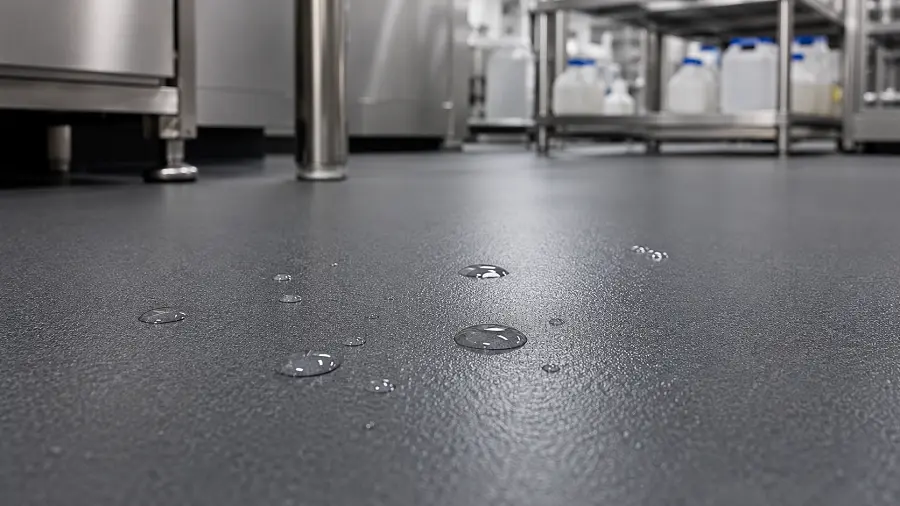
Chemical Resistance, Acids, Solvents and Cleaners
Commercial epoxy and PU concrete resist acids, alkalis, solvents, fuels, hydraulic fluids and the cleaning chemistries used in food and pharmaceutical processing. Chemical resistance is rated under ASTM D543 and EN 13529. Specification depends on the chemistry profile of the operation: pharmaceutical labs need broader chemical resistance than food processing, and chemical storage areas need different resistance from general manufacturing. Each resin chemistry carries a chemical resistance profile matched at survey rather than carried across from a default.
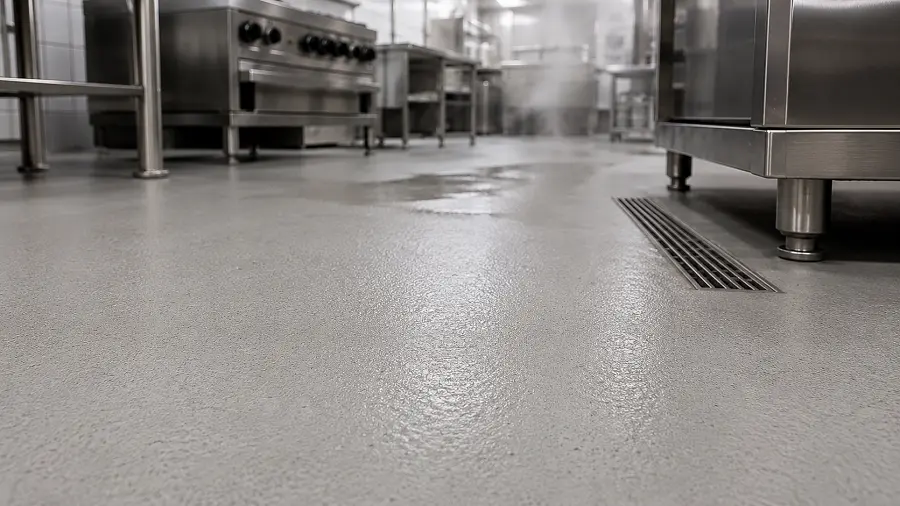
Thermal Cycling, Heat Shock and Sustained Temperature
PU (polyurethane) concrete is the standard specification for environments with thermal shock: commercial kitchens with steam cleaning and boiling spills, cold rooms with frequent door cycles, food processing with hot and cold thermal swings. The service temperature range across the resin family is -40°C to +130°C, with PU concrete handling the widest sustained range and recovering from thermal shock without delaminating. Epoxy alone is insufficient for sustained heat-shock environments and is specified in cooler operations.
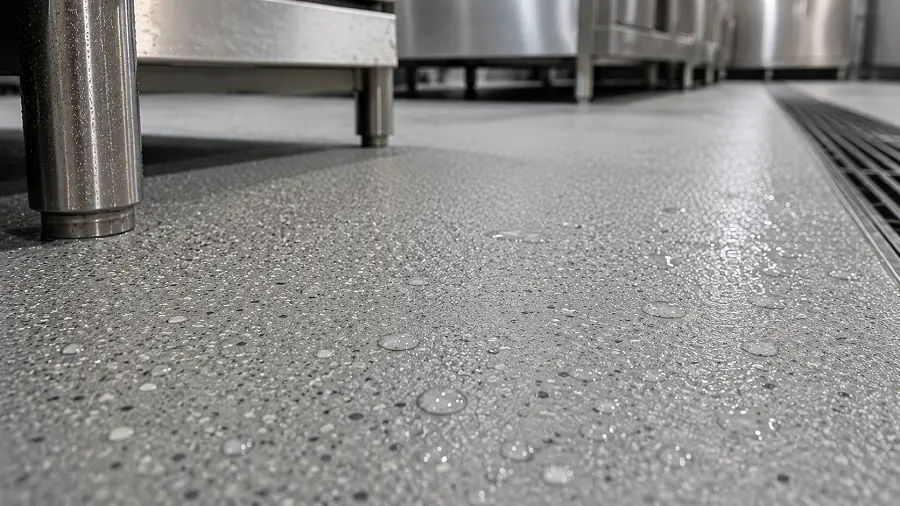
Slip Rating, R10 to R13 Broadcast Aggregate
Standard self-levelling epoxy delivers an R10 slip rating dry. Broadcast aggregate, such as quartz, silicon carbide or anti-slip granules applied into the wet resin layer, delivers R11 to R13 under DIN 51130. This is specified for wet kitchen production zones, brewery floors, vehicle wash bays, hospitality back-of-house and F&B service corridors. The aggregate broadcast is selected by particle size and density to match the slip rating the operation requires.
Static Control, ESD and Conductive Variants
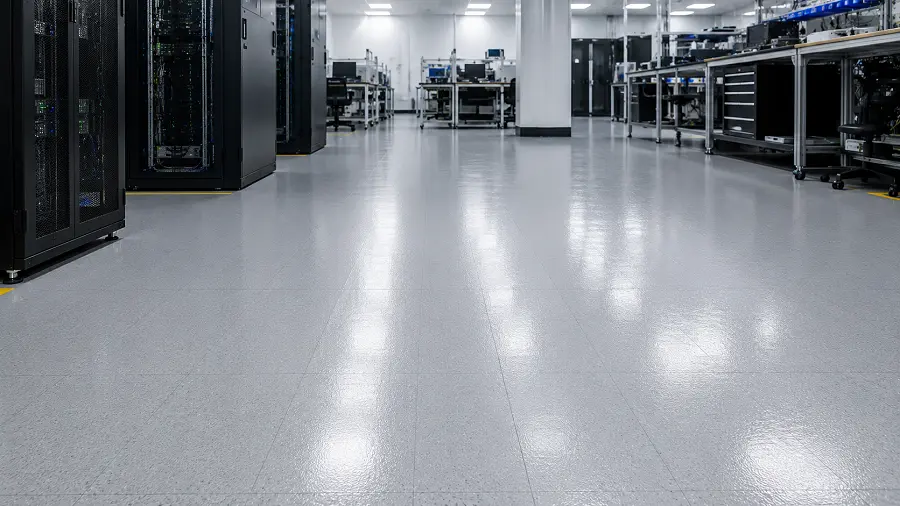
ESD (electrostatic dissipative) and conductive epoxy systems serve electronics manufacturing, server rooms, pharmaceutical packaging and explosive-atmosphere zones. System resistance is specified under IEC 61340, static-dissipative at 10⁶ to 10⁹ ohms or conductive at 10⁴ to 10⁶ ohms, matched to the equipment standard where the operation requires it. ESD resin is specified where vinyl ESD is insufficient, typically in heavy-traffic zones with chemical exposure that vinyl cannot handle.
Commercial Resin by Sector
Commercial resin's use cases concentrate in three primary sectors where chemical resistance, thermal cycling and slip safety specifically lead: industrial, healthcare laboratories and F&B kitchens. Automotive and parts of retail use resin secondarily. In sectors where soft surfaces and welded sheet vinyl lead, such as office, hospitality public areas, retail customer zones and education general spaces, resin is the wrong specification.
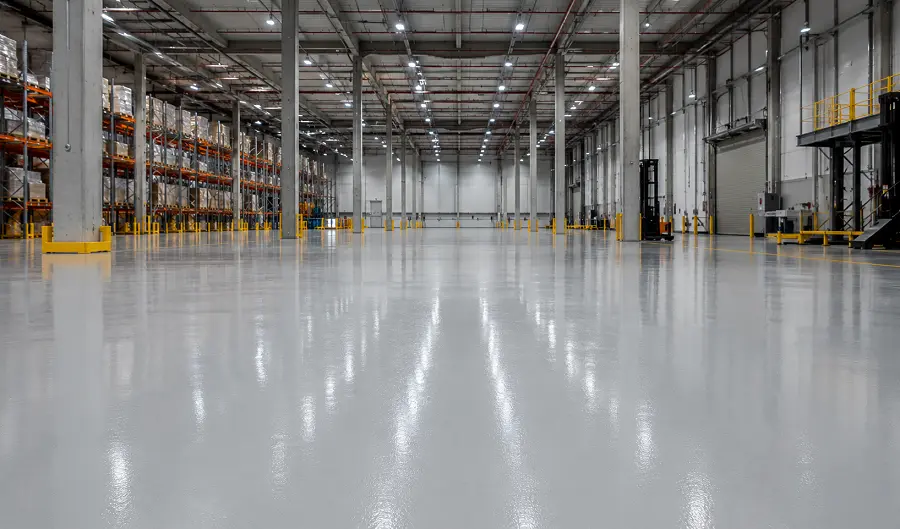
Industrial & Warehouse Resin
Self-levelling epoxy across general manufacturing, warehousing and logistics floors for chemical resistance and impact tolerance. Heavy-duty epoxy mortar at 6 to 9mm for forklift-rated production zones. PU concrete in cold storage and food processing for thermal cycling. Anti-static and ESD epoxy in electronics manufacturing, server rooms and cleanrooms, specified to IEC 61340 resistance ranges.
Full industrial sector depth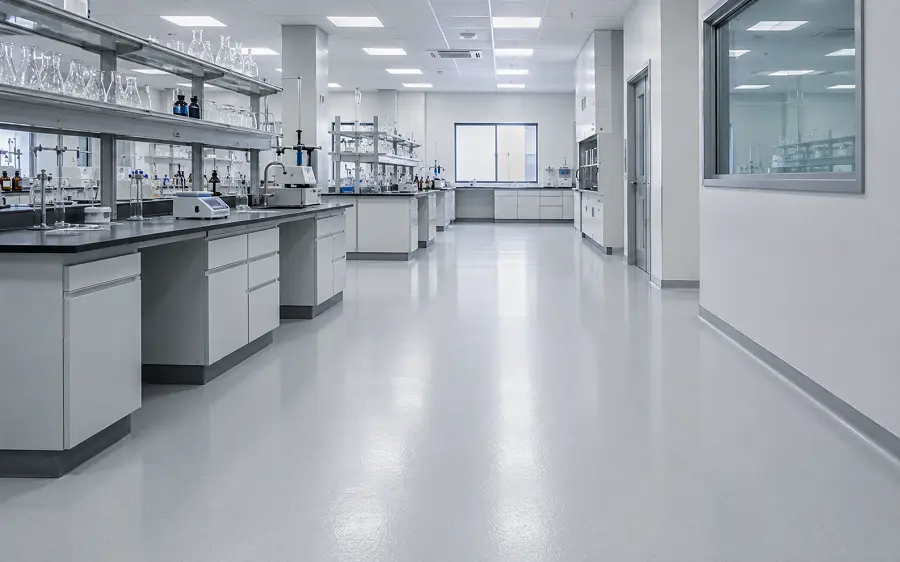
Healthcare Laboratory & Pharmaceutical Resin
Self-levelling epoxy in chemistry, biology, pathology and dental labs for chemical resistance against reagents. PU concrete in pharmaceutical production and cleanrooms with intensive disinfection cycles, and ESD variants in pharma packaging and electronics-sensitive labs. Used in healthcare laboratories and pharmaceutical environments only: sterile clinical zones such as operating theatres, ICUs and wards use homogeneous heat-welded sheet vinyl.
Healthcare lab and pharma depth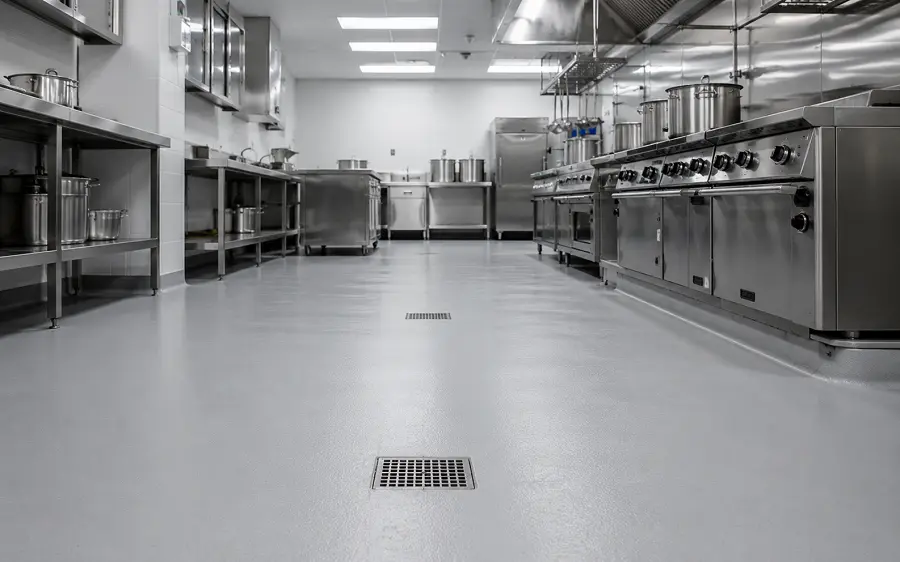
F&B Commercial Kitchens & Hotel Kitchens
PU concrete is the standard specification for commercial kitchens: hotel kitchens, restaurant kitchens, food court production zones, café back-of-house and food processing. Thermal cycling, hot-water cleaning, oil exposure and wet-zone slip safety are the operational reality kitchens generate, and PU concrete handles all four, with HACCP-aligned specification and USDA-equivalent compliance and an R11 to R13 slip rating from broadcast aggregate. Hospitality kitchen depth at hospitality sector page; retail F&B kitchen context at retail sector page.
Automotive workshops, vehicle service bays and showrooms use epoxy and polyurethane coatings extensively, but our specialist network site at garageflooring.ae carries the full automotive-focused resin range, including polyurea, polyaspartic, metallic epoxy and microcement decorative finishes. Commercial automotive procurement should route through that specialist.
Resin is not the lead specification in office workstations, hospitality public areas, retail customer-flow zones, education classrooms or healthcare sterile clinical zones. Where these sectors specify resin, it is typically in back-of-house, mechanical equipment rooms or service zones only, covered on the relevant sector pages.
Choosing the Right Resin Chemistry
The commercial resin chemistry decision rule is straightforward: epoxy for general chemical resistance and cost-effective coverage, PU concrete for thermal cycling and food or pharma operations, MMA for fast-cure refurbishment where the operation cannot accept extended downtime. Each chemistry is selected by the dominant operational demand at the zone, with thickness specified to the impact and chemical load.
| Specification | Epoxy | Polyurethane (PU) Concrete | MMA |
|---|---|---|---|
| Lead use case | General industrial, chemical resistance | F&B kitchens, pharma, cold storage | Fast-cure refurbishment, cold zones |
| Chemical resistance | Broad (acids, alkalis, solvents) | Broad, better alkali resistance | Broad, fast-track chemical resistance |
| Thermal range | -10°C to +60°C standard | -40°C to +130°C, thermal shock | -40°C to +90°C, thermal shock |
| Cure time | 12 to 24 hours light traffic | 12 to 24 hours light traffic | 1 to 2 hours full cure |
| Typical thickness | 200μm to 3mm coating; 6 to 9mm mortar | 6 to 9mm mortar | 2 to 4mm |
| Slip rating capability | R10 standard / R11 to R13 broadcast | R11 to R13 broadcast standard | R10 to R13 |
| ESD / anti-static | Yes, IEC 61340 ranges | Yes, IEC 61340 ranges | Yes, IEC 61340 ranges |
| Compliance | ASTM D543, EN 13529 | HACCP, USDA-equivalent | ASTM, fast-track sectors |
| Best for | Warehouses, factories, labs, parking | Hotel kitchens, food processing, dairy | Live-operation refurbishment, cold rooms |
| Cost positioning | Most cost-effective resin | Mid to high | Highest (fast-cure premium) |
The table is the chemistry-selection citation asset. Each row is matched at survey against the operation's chemical, thermal and downtime profile rather than carried across from a default. Wrong chemistry means floor failure in months.
When to Choose Commercial Resin
Commercial resin wins in specific zones and is the wrong material in others. Here is the honest decision matrix.
Resin wins when:
- Chemical resistance is the operational requirement, in labs, F&B and pharmaceutical production
- Thermal cycling is constant, in commercial kitchens, cold rooms and food processing
- Heavy point loads and impact dominate, in industrial mortar systems and forklift zones
- Seamless monolithic continuity is required, in cleanrooms and sterile pharma production
Other materials win when:
- Hygiene with design and acoustics together is needed, where homogeneous heat-welded sheet vinyl leads sterile clinical zones, covered on our commercial vinyl and LVT page
- Acoustic comfort and brand expression lead, where carpet leads hotels, offices and libraries, covered on our commercial carpet page
- Dimensional stability with click-lock retrofit is the priority, where SPC leads glass-walled offices, covered on our commercial SPC page
- Large-area aesthetic with light reflection leads, where polished concrete leads retail and modern showrooms
For the broader commercial flooring decision across all materials, see our commercial flooring types guide. For automotive workshops and decorative resin specifically, including metallic epoxy, polyurea and microcement, see our specialist site at garageflooring.ae.
Why UAE Commercial Operators Choose Us for Resin Specification
Resin is install-critical and chemistry-critical at once. The wrong chemistry fails under the operation's chemical or thermal load, and even the right chemistry fails if the substrate is not prepared. We specify by chemistry against survey and prepare the substrate to the discipline resin demands.
Since 2013 in UAE
1,500+ commercial projects delivered, with resin across industrial, healthcare laboratory, F&B kitchen and pharmaceutical sectors.
Chemistry Matched to Zone
Epoxy, PU concrete and MMA selected by the operation's chemical, thermal and downtime profile rather than a default.
Substrate Preparation Discipline
Concrete moisture testing, surface profiling by shot-blast or grind, and primer specification handled before the resin lands.
HACCP and Compliance Documentation
Kitchen and pharma specifications aligned with HACCP, USDA-equivalent and ASTM/EN standards, documented at survey.
Material Depth Through Our Network
The full resin range, including automotive coatings such as polyurea, polyaspartic, metallic epoxy and microcement, is available through our specialist network site at garageflooring.ae.
Frequently Asked Questions About Commercial Epoxy and Resin Flooring
What is commercial epoxy flooring?
Commercial epoxy flooring is a seamless resin system formed by reacting epoxy resin with a hardener to create a continuous, chemically resistant surface on a concrete substrate. It is specified across industrial, laboratory and food-processing environments for chemical resistance, impact tolerance and hygiene continuity. Systems range from thin coatings at 200 microns through to heavy-duty mortar systems at 6 to 9mm by use.
What is the difference between epoxy and PU (polyurethane) concrete?
Epoxy delivers broad chemical resistance and a cost-effective finish for general industrial and laboratory floors at standard temperatures. PU concrete, also called polyurethane cement, handles thermal cycling and heat shock from -40°C to +130°C, which is why it is the standard for commercial kitchens, cold storage and food processing. The decision is driven by thermal demand more than anything else.
What flooring is best for commercial kitchens?
PU concrete is the standard for commercial kitchens because it handles the four demands kitchens generate at once: thermal shock from steam and boiling spills, hot-water and chemical cleaning, oil exposure, and wet-zone slip safety. Specified with R11 to R13 broadcast aggregate and HACCP-aligned, it outlasts standard epoxy, which fails under sustained heat-shock cycling in a kitchen environment.
How much does commercial epoxy and resin flooring cost in the UAE?
Commercial epoxy in the UAE starts from around AED 70 per square metre (sqm), about AED 6.50 per sqft, for standard self-levelling systems, with anti-static epoxy from around AED 95 and PU concrete and heavy-duty industrial mortar systems reaching AED 200 and above. For the full ranges by system, see our commercial flooring cost guide.
Can epoxy handle hot water cleaning and steam in food processing?
Standard epoxy is not suited to sustained hot-water and steam cleaning, which is why PU concrete is specified for food processing and commercial kitchens. PU concrete tolerates thermal shock from -40°C to +130°C and recovers from steam and boiling-water exposure without delaminating, where standard epoxy can soften or debond under repeated heat-shock cycling.
What is ESD epoxy and where is it specified?
ESD (electrostatic dissipative) epoxy controls static charge to protect sensitive electronics and personnel. It is specified in electronics manufacturing, server rooms, pharmaceutical packaging and explosive-atmosphere zones. System resistance is matched to a target range under IEC 61340, either static-dissipative at 10⁶ to 10⁹ ohms or conductive at 10⁴ to 10⁶ ohms, depending on the equipment standard the zone operates under.
Where is epoxy not the right specification?
Epoxy and resin are not the right specification for office workstations, hospitality guest areas, retail customer-flow zones or healthcare sterile clinical zones, where carpet, LVT or heat-welded sheet vinyl lead. Resin suits industrial, laboratory, pharmaceutical and kitchen environments where chemical resistance, thermal cycling or heavy load lead the decision, not general commercial or design-led spaces.
How long does commercial resin take to install?
Commercial resin install time depends on chemistry and substrate. Standard epoxy and PU concrete typically reach light foot traffic in 12 to 24 hours and full cure over several days, after substrate preparation. MMA cures fully in 1 to 2 hours, which is why it is specified for live-operation refurbishment where downtime must be minimal. Substrate preparation time is established at survey.
Start Your Commercial Epoxy or Resin Flooring Project
Commercial resin performs when the chemistry is matched to the operation's chemical, thermal and downtime profile, and the substrate is prepared to the discipline resin demands. We survey free of charge, specify epoxy, PU concrete and MMA across industrial, healthcare laboratory, F&B kitchen and pharmaceutical projects, then supply and install under one contractor with substrate-preparation discipline and HACCP-aligned documentation. For automotive resin and decorative finishes, our specialist site at garageflooring.ae carries the range. Operating from Al Quoz, Dubai's flooring and wholesale hub, we cover Dubai, Abu Dhabi and the wider UAE. Book a site survey and we will specify and quote your project properly.
Or call +971 50 362 7192